The writers who let you watch them write
Werber’s cathedral of strings, Auster’s blue notebook, Tesson’s cabin on the Baikal. On the books that put the writing desk inside the frame, and on what it would take to sit down at one.
By Malak Yacoubi
A walk through one Paris evening, a 25-year-old painter and a room full of people deciding what counts as good.
By Anas Ben Mejdoub
Paris · 4 August 2026
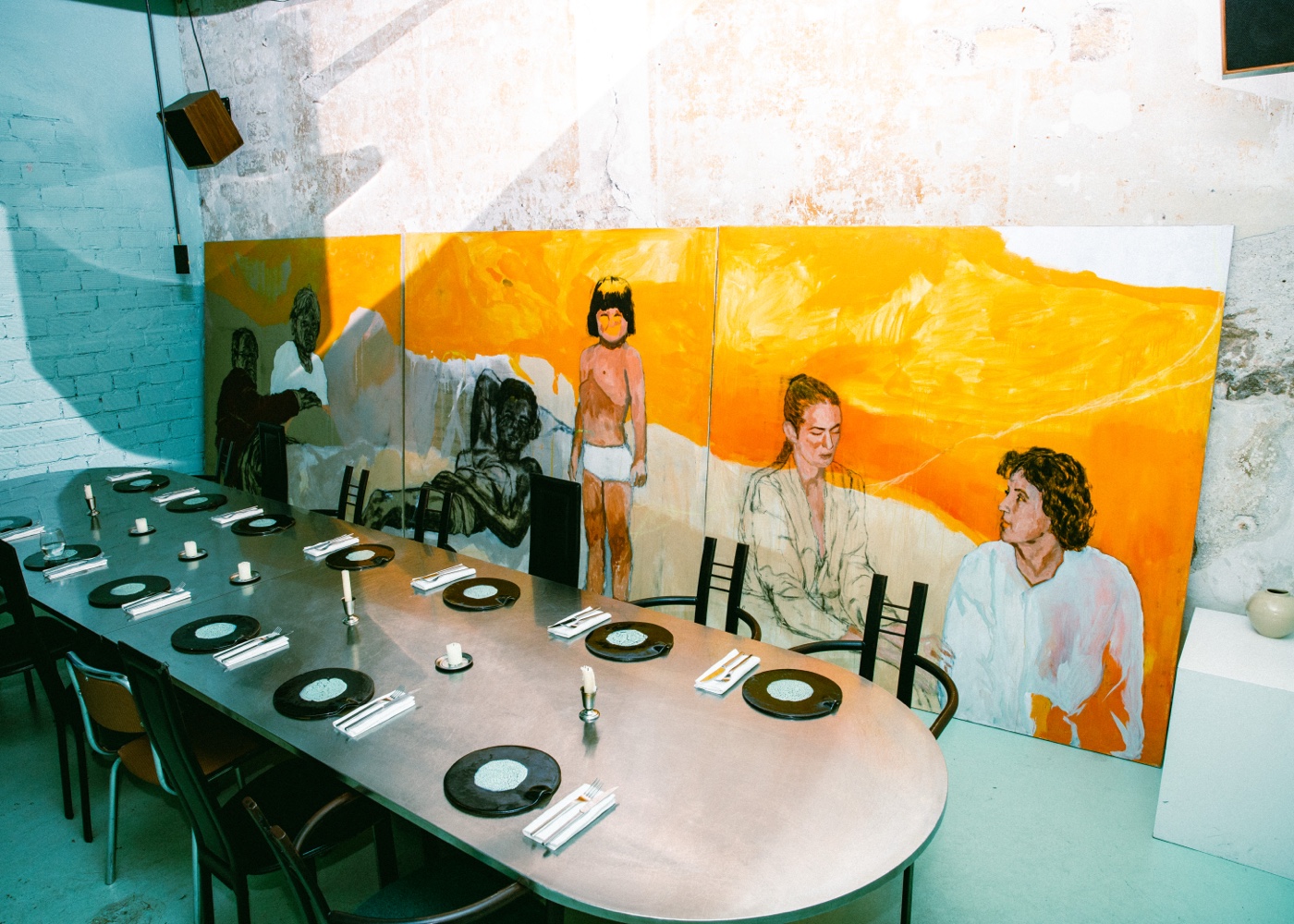
The room at Halo, in the second arrondissement of Paris, laid for the Bodéga night on 2 July. Photograph by Arthur Loiseau.
July 2: Paris is ablaze and every face I meet on Saint-Sauveur street looks like melting wax. I lock my lime bike and make my way to Halo, where César is organizing the second Parisian edition of Bodéga. He’s showing Elias Loudiyi, a 25-year-old French-Moroccan artist, fresh out of Beaux-Arts de Paris. More than one person taking themself seriously in the art world told me he’s a good artist.
It’s 19:00 and I just arrived at Halo, an eclectically classy restaurant. I’m an hour late to the show, yet I am the first one to arrive. César tells me that one hour late is too early in Paris, but I am happy for my disregard for french manners, because I got Elias all to myself for the better part of the next hour. We sit in front of this giant painting he made. A scene where a middle aged man appearing to be his father’s uncle is quarrelling with three young kids playing on the ground, somewhere in rural Morocco decades ago. He explains how his art is an expression of time, of family, of things around the history of his father, of his own.
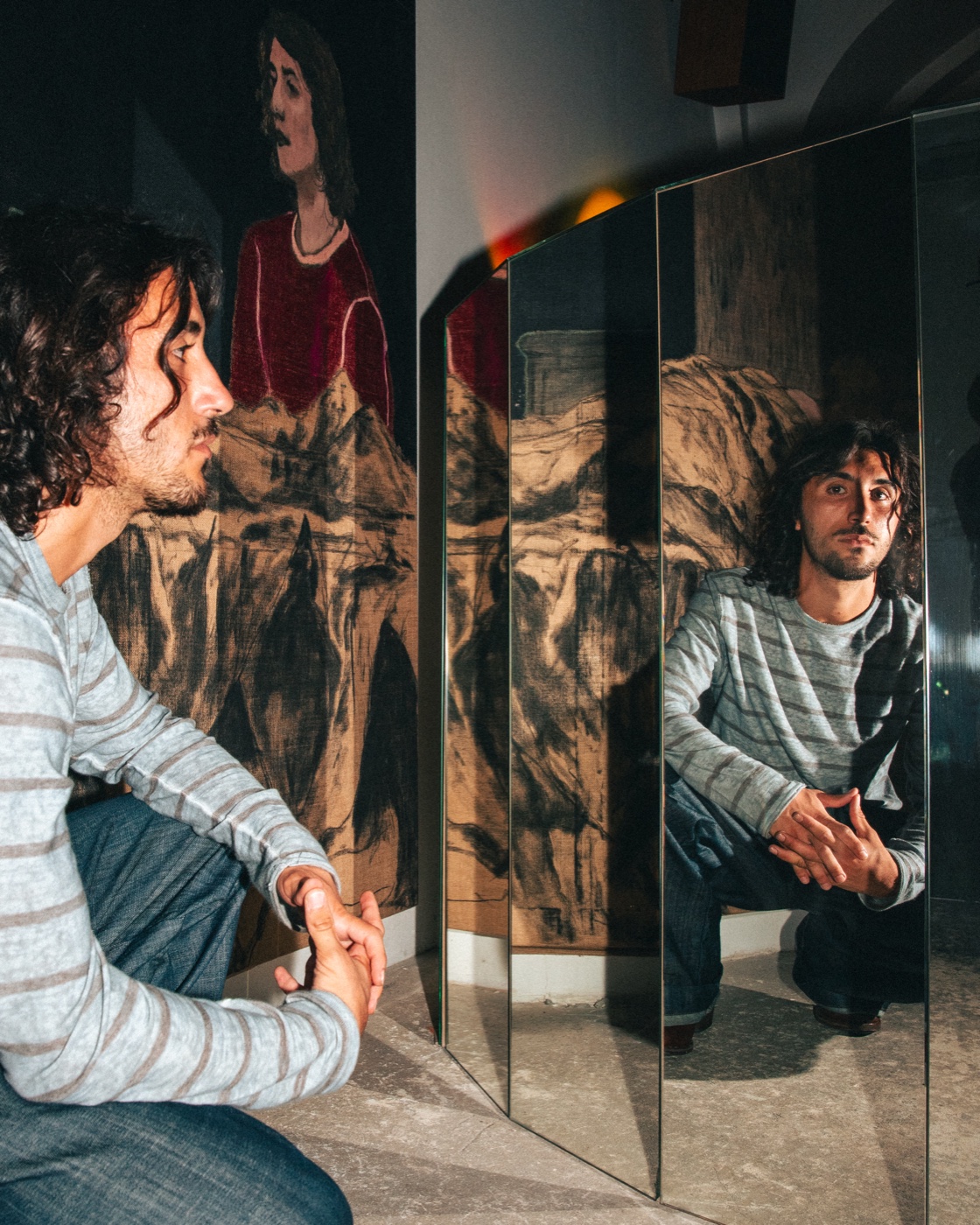
I liked Elias as a human, yet I found myself wondering whether I liked him because Halo is a beautiful place and he emulated his ideas clearly and with conviction, or whether I liked his art, or whether I liked him because César and three other people whose opinion I care about told me he is a great artist.
Elias’ paintings were truly grandiose, yet they didn’t speak to me in that way. While looking at them, I was ashamed to feel almost bored with the confrontation to the duality of identities, french and moroccan, which, as a global Moroccan, I have revisited too many times already. His art is not only about that of course, but it was the theme that struck me most. I did, however, find the idea of painting your kins’ holiday pictures to be an unseen part of the identity of many french moroccans who go back to morocco for vacation. I liked the idea that a Moroccan born and raised in France would recognise themselves in Elias’ pieces, even though I had no interest in comprehending that identity myself. Almost like when you see a marriage proposal on the street while vacationing in Mallorca: it changes nothing to my day but that ring looks cool and I am rooting for you dude.
I met César Bouttier a few weeks after he left his job as advisor to ex-French Prime Minister Gabriel Attal, and a significant time working in tech before that. My first impression of César was that of a very well put together french man, with long hair neatly kept, an accent in english that suggested he grew up around globalised french people, who kept the french touch alive. He told me his life was more about “going to exhibitions and thinking about art than it was about his actual work.” His friends kept asking him for advice that had nothing to do with politics and everything to do with arts, which, when seeing french political news, is only fair. So somewhere between the speech-writing and the advising, he did what we all do these days and thought to himself, let’s start Bodéga.
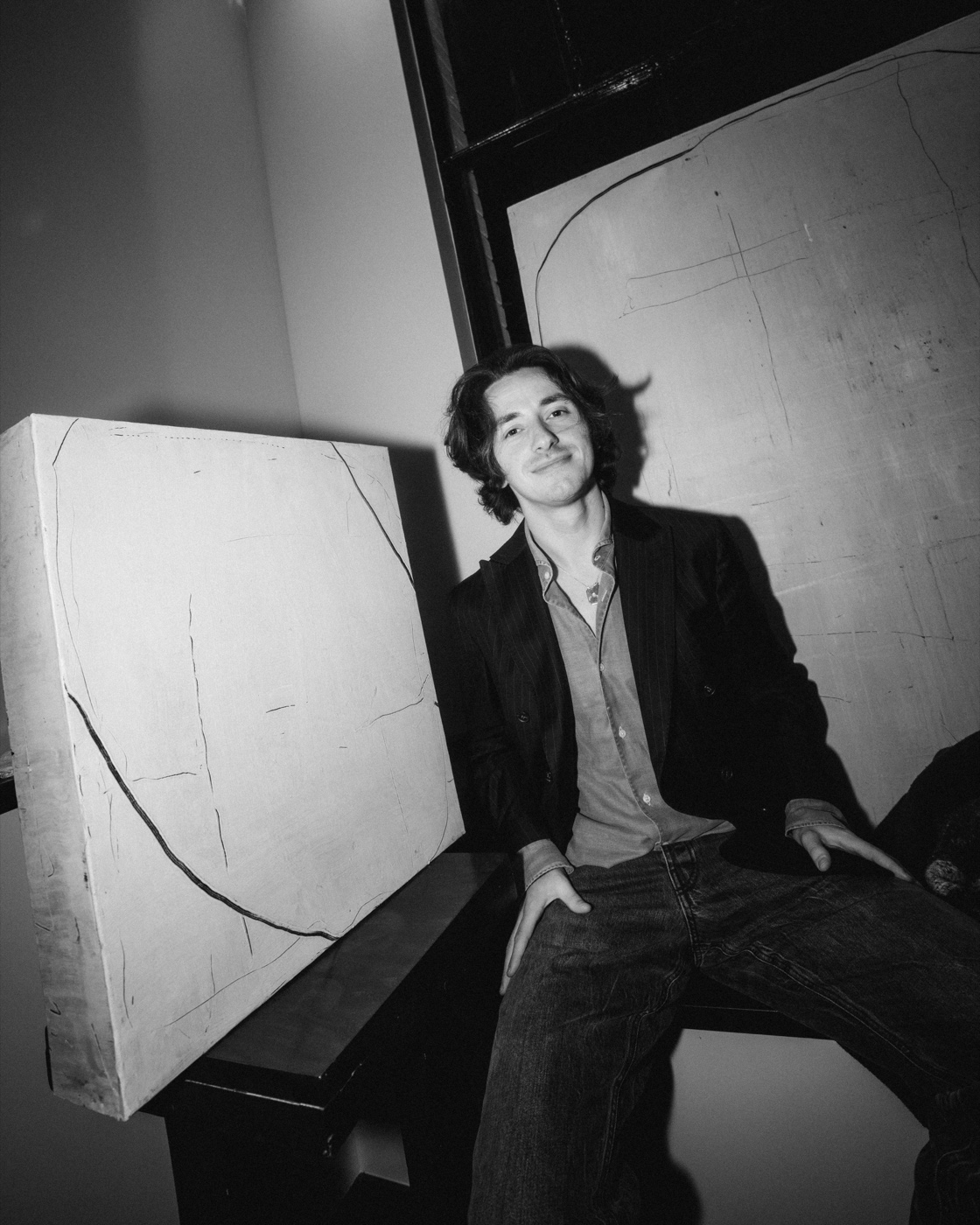
Bodéga aims to “democratize access to art as an alternative asset (...) Rather than investing in stock options or watches, I wanted to make people realize that there’s an entire personal journey and trajectory that comes along with collecting art,” César explains.
This is what a Bodéga event looks like: César invites a few people he knows (who can also invite their friends) and some art world professionals in a cool and vibey space to discover an emerging artist’s work, in the presence of said artist. He’s held four Bodéga events so far, in London, Paris and New York, with Elias Loudiyi being the fourth show.
The modus operandi sounds simple, and yet it is practically non-existent in the art world. At least, that’s what Rania, who’s an arts journalist, tells me:
“As someone who attends four to six exhibitions a month, I think Bodéga is a desperately needed break from formal shows. It moves away from traditional white cube exhibitions [a white cube is an art gallery or museum space defined by plain white walls], and from crowds where you can barely talk to anyone about anything, let alone about the art sometimes. The gallerist is focused on the people who look like they have serious money to spend, i.e. the people over 50; the journalists and the media are pulling away from the artist all night long; and some people hang out in testudo formations gossiping about who’s who in the room. As a below-30-year-old enthusiast in the art world, unless you get introduced around by an established someone within it, you’re a nobody.”
Rania Kettani
At some point during the night at Halo, I found myself sitting next to Emmanuel and Katherine, a couple of elegant 50-year-olds wearing perfectly tailored and glamorous suits, who had a clear taste for funky conversations with strangers: César’s parents. I was the stranger. Half an hour into our conversation, I concluded César’s parents were no different than most Gen-Zers’: wonderfully confused by their children’s life occupation, yet displaying an unconventional sense of pride and chillness about it all.
“I don’t know what’s wrong with wearing a suit these days,” said Emmanuel.
Some moments later, my friend Dina El Moukhtari, who works as a young gallery professional, and known amongst our friend group for being the Parisian cool girl despite her lack of a red passport, finally arrived. She found the event “really cool,” and loved that it was held in a restaurant rather than a traditional gallery. To her, the aesthetic of Halo perfectly complemented that of Elias’ art:
“The ambiance is very warm, and dancey. J’adore.”
However, she also revealed wondering whether the one night was “actually profitable” for César or for Elias, given what she knew of the art world. Dina works with collectors of a particular caliber (aka real cash cows), “an older crowd who schemes on how they can maximize and optimize their annual art-spending to cheat their social taxes,” as Rania would say. She was later surprised to learn that, as César reported, Elias’s show was in fact a hit.
Her assumption is exactly what César is betting against: that a Millennial and Gen-Z crowd, unlearned in white-cube etiquette, should not be considered a serious market base. I live in London, a city full of HENRYs (High Earning Not Rich Yet, a.k.a. another way to name people waiting for their inheritance to kick in). HENRYs are a relatively young subset of the 1% who act and look like they are poor but have Swiss and Luxembourg bankers on speed dial for when rainy days hit their 10-year old Monzo student account. César’s goal, as I read, is to create enjoyable spaces that make art feel accessible to them, even though the piece those young crowds are seeing will probably cost them what they made in four months at their first job (which was really not that long ago).
While the sun was setting on the reflecting tables of Halo, the it-crowd came out: a friend of César’s friend who models in LA and is passing by in Paris, two french guys whose recent move from Marylebone to the first arrondissement de Paris was so fresh I could decisively smell their allure, a young top-tier global gallery branch manager telling me about his best friend who launched a venture capital fund, and of course, the children of the people you may not know but should.
I had a great time. Like, really great time. The people were fun and everything looked beautiful.
Something I have noticed in the art world throughout the years: every time I go to a gallery, I notice people bored to death, almost never looking at the art. Similarly, in many fairs and openings I have been to, the humans I meet have dull lives in many ways, and art convenings seem to be helping them get out of it. César brought people from different walks of life, and the art of Elias would truly speak to some of the people you would normally never encounter in a gallery.
Rania would say that art needs to be seen and studied by people who take the time, and who have a capacity to understand and enjoy it intellectually. But honestly, I think Elias’s art would be better off seen by everyday people who are in the middle of a small city in Morocco and who had cousins come and go from France in the summers in the 90s, whether they have an affection for consuming and intellectualising art or not. I think they would feel it so much more than I did, as I felt unfit to enjoy any of it despite potentially being able to own it.
Which brings me back to the question I could not answer in front of the painting. Elias studied at one of the most reputable art schools in the world (something most professionals and collectors really care about for some reason) and you can sense his technical mastery. Yet, I can’t help but wonder, how much is my brain tricking me into seeing it that way? Because of who’s present in the room, of who I brought to the event myself, and what my financial and social incentives are. I wonder what the contrast is between how much people care about an artist, and how much they were told they need to care about it. And how much that’s the case on a daily basis in the art world.
Maybe I don’t understand anything about art, and yet this night was thought-provoking. I left early, went to a terrace to see a friend, and back home to order a five guys, in the 30°C heat of that night. ■
Werber’s cathedral of strings, Auster’s blue notebook, Tesson’s cabin on the Baikal. On the books that put the writing desk inside the frame, and on what it would take to sit down at one.
By Malak Yacoubi
A meditation on kittens, capitalism and the bluish colour of veins, and what is left when life stops being a list of milestones.
By Ghita Benhayoune
Meet the Church of JADE. She won The X Factor with Little Mix, went solo, and made some of the most technically ambitious pop of the decade. Most people still cannot name a song.
By Rezi Getsadze
We’re at the stage of the future where our species seems to be moving past privacy concern all together for the sake of no longer doing exhausting chores. One company will clean your apartment for free in exchange for the footage. In more than 50 countries, the same trade is now being made by the hour.
By James
Your girlfriend deserves a proposal like Malak Yacoubi’s, and I will personally hunt you down to the ends of Greece if you don’t give her her Mamma Mia moment.
By Rania Kettani
Known on Strava for snatching the podiums on the hardest segments around, Alessandro Motta lined up at the Zurich City Triathlon chasing a real one. A wrong turn cost him a minute; a blown tyre, four kilometres from the bike finish, cost him the rest. Instead of stopping, he ran it barefoot. Interview with Rania Kettani.
By Rania Kettani
A short note when a new piece runs.