
African VC returns are up
Eleven exits, realised multiples of up to five times, and, rarest of all, actual cash back in investors' pockets.
By James
We’re at the stage of the future where our species seems to be moving past privacy concern all together for the sake of no longer doing exhausting chores. One company will clean your apartment for free in exchange for the footage. In more than 50 countries, the same trade is now being made by the hour.
By James
MUNICH · 22 July 2026
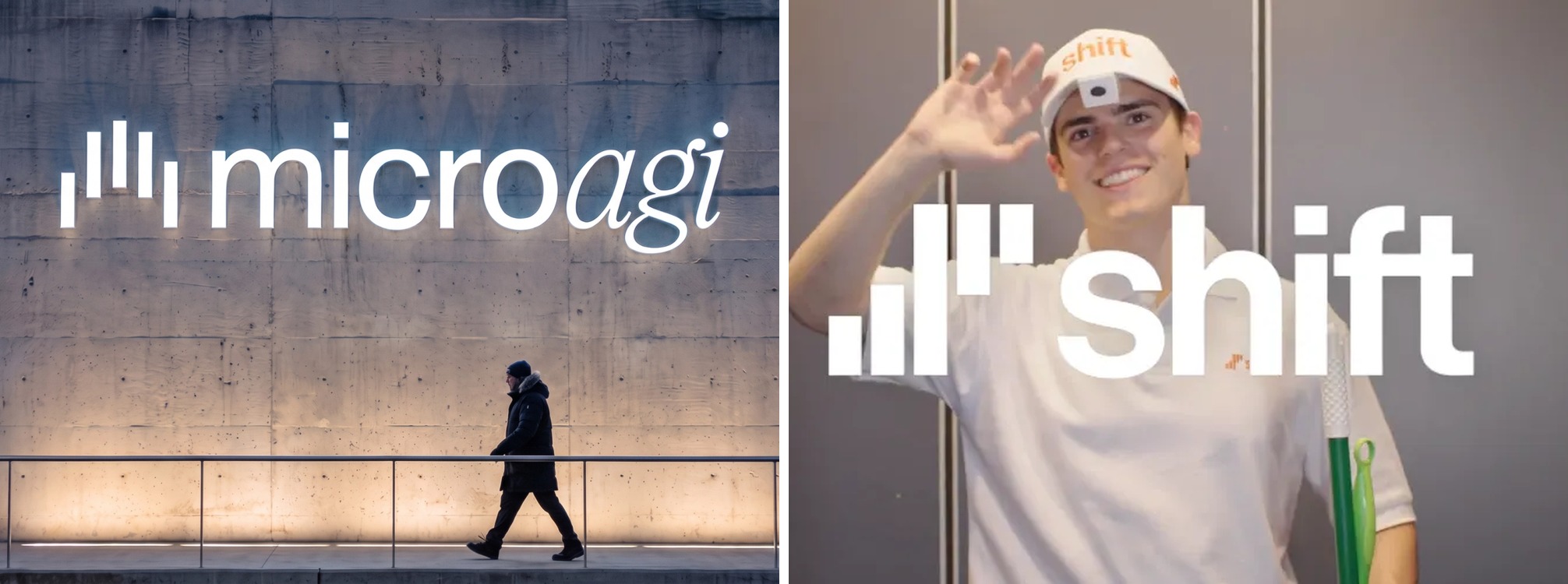
microagi in Munich, and shift, the arm that pays people to be filmed.
Last spring in New York, a company named shift started cleaning people’s apartments free of charge. And no, it wasn’t thanks to Zohran Mamdani.
The offer: “You get a spotless apartment. We get training data. Everyone wins.” shift sends a cleaning professional to your place, and in exchange, all you have to do is consent to them recording cleaning footage in your house. In San Francisco, that same company added a twist to the idea with private chefs; the offer went viral.
shift is the data-collection arm of microagi (both companies style their names in lowercase; this piece preserves that styling throughout), a data research and deployment lab started from a hacker house in Munich. The company records first-person cleaning footage to train future autonomous robots that can be deployed at industrial scale. On 16 July, the startup raised $55 million in a seed round led by Hummingbird, alongside Northzone, LocalGlobe, Village Global and redalpine. This is the largest seed round ever raised by a German company, according to Sifted.
microagi is not the only company doing this, and that is really the story. In about two years, without anybody voting on it and mostly without anybody noticing, an entire industry has appeared whose product is a recording of ordinary people doing ordinary things with their hands. One of the American companies in it has about 4,000 people filming in 71 countries, and it is not the largest.
The scarcity these companies are trading on is easy to state: large language models (LLMs) developed in the last five years are trained on written data available on the internet, but there is no equivalent for an archive of visual human movement. In other words, nobody has spent thirty years of their life recording themselves picking up a wrench every day (though, if you have, we’re letting you know that data is gold right now).
AI-powered robots are excellent in laboratory research but useless in a factory without the kind of training data that first-person recording provides, and a few players are betting on that gap, on the training data being worth collecting now, and on robots being worth deploying once it exists. Scale AI and Encord, both known until recently for labelling text and images, have also started recruiting people to record themselves, and Scale AI announced it had gathered over 100,000 hours of footage so far. Micro1, based in Palo Alto, has thousands of contract workers filming household tasks and sells the footage to Tesla, Figure AI and Agility Robotics. At the same time, DoorDash pays delivery drivers to film their own chores.
“We put our engineers on site with each customer, and the system learns from their real operations and feeds that back into the next run,” explains Nico Nussbaum, microagi’s chief technology officer. “So every month we’re there they pull a little further ahead of their competitors.”
MIT Technology Review named the kind of Physical AI being developed as one of 2026’s breakthrough technologies.
In China, this exact kind of data collection is organised at a much larger scale, with direct support from the state. JD.com’s programme in Suqian plans to recruit 100,000 employees and 500,000 external workers over two years, with a target of 10 million hours of training data. Vendors in Guangdong fit assembly-line workers with head cameras and wrist sensors. Workers in state-owned elderly care centres and farms wear VR headsets and exoskeletons so robots can replicate their movements.
In 2025, the median age in the European Union reached 44.9, up from the 39.6 figure recorded in 2005. The European Commission estimates that by 2050, the EU’s workforce will shrink by 18.8 million people.
“Your most experienced people retire this decade, and their replacements were never born. Reshoring only works if the robots do,” explains Bercan Kilic, microagi’s chief executive.
Meanwhile, in 2024, China installed 295,000 robots in its factories, 54 per cent of the world’s total, against 34,200 in the United States, according to the International Federation of Robotics.
Basically, the European continent is ageing quickly, not automating fast enough, and has no plan for the difference. There are other answers, and they are all real ones: working later, getting more people into work, squeezing more output out of each worker, immigration. None of them is arriving anywhere near the size of the hole, and immigration at the required scale is not a very popular political solution in most countries with an ageing demography. Which leaves automation as the answer being funded, whether or not it turns out to be the answer.
The money is following that logic, and in Europe a good deal of it has followed it into a hacker house in Munich.
The pedigree of the founding team is not very typical: Kilic was previously an aerodynamics engineer at Red Bull Racing and a professional e-sports player, while Yoan Iliev came from Mercedes-AMG Petronas, just on the other end of the pit lane. Anton Poletaev was a researcher at the Alan Turing Institute in London; Nussbaum was an engineer at RWTH Aachen. Artjem Weissbeck co-founded Charles, a WhatsApp e-commerce platform; he was named on the 2018 list of Forbes 30 Under 30 (Europe) for his earlier company, Kapten & Son.
The racing background is important. Formula One engineers are expected to innovate at all times. F1 cars face a fixed problem and a fixed deadline every fortnight, and the industry’s innovation centres have basically become a standard of high achiever pedigree and leading spaces for European tech innovation, from defence to manufacturing. It makes sense that these guys are the ones behind microagi.
microagi’s solution is thus anticipating Europe’s needs in 2045 by powering the kind of solution that could work. However, the recording technology is mostly being deployed in non-European countries, with India, Nigeria and Argentina amongst the largest bases; countries that are growing fast and will have no shortage of workers by the mid-21st century.
shift, microagi’s own data arm, pays the people it sends out to record at around $20 an hour in New York and San Francisco. Zeus, a medical student in Nigeria, is paid $15 an hour for the same work by Micro1, a separate company based in Palo Alto with no connection to microagi, which has recruited about 4,000 people to film themselves across 71 countries. Gao Bo, a stay-at-home mother in Shandong province, films herself doing chores six hours a day for one of the Chinese programmes, at 20 yuan an hour, about $3.
Twenty dollars an hour is above the New York City minimum wage, which rose to $17.00 on 1 January 2026. Nobody in this story is being paid below the going rate where they live.
“No one had paid me to cook and do laundry before,” Gao Bo explained to Rest of World. Her flat, she says, is now spotless from the repeated cleaning.
The footage being recorded is of the same, identical job. Yet, the wages vary significantly. So what explains the discrepancy? The answer lies in geography and individual economic constraints. The people powering the system are from the same countries that Europe already relies on for lower-cost manufacturing.
The irony sits right there: Zeus and Gao Bo are being paid, by the hour, to teach a machine how to do the work they’re currently doing. Neither of them expects to be replaced, but by the time the robots they’re training are ready to work a factory floor or a kitchen, the same demographic doing the labour now is the one with the least reason to need robots.
This is also about who can freely say no, and the people filming their own hands folding laundry for $3 an hour mostly cannot afford to say no.
Furthermore, the copyright to the data recorded has no legal category. A worker consents to being filmed, but holds no property claim over the capabilities derived from their recording. GDPR covers their face. The AI Act covers the system. Nothing at all covers the part everybody is actually buying, which is the knowledge of how far to turn a wrist and how hard to press before something breaks. You can ask for your footage to be deleted, and the model that already learned from it does not forget. There is no clear liability defined either, despite the European Union attempting to legislate the field: if a robot trained on Gao Bo’s afternoons breaks somebody’s arm on a factory floor in 2031, nobody can currently tell you whose fault that is.
Unsurprisingly for a startup like microagi, and for most of the players in their industry, very little has been done so far in terms of deployment. At the moment, only five of microagi’s customers benefit from the data collected for automotive industries, logistics and food, and only one of them is approaching deployment. Kilic wants physical AI technology running more than 20 or 30 million robots within five years, and says anything less would be a failure. On the $55 million raised in the seed round, he stated:
“It’s one-billionth of what Europe needs.”
microagi is the example here because it raised the largest seed round in its country’s history, and because it publishes what it collects and what it pays. The companies worth worrying about are the ones that do neither.
Whatever the speed of deployment, the footage is currently being recorded by different companies in over 50 countries. If the robots are ready within the next five years, they will be used then, and if they are ready in the next twenty years, they will also be used then. The archive is permanent, even if consent was bought per hour.
Eleven exits, realised multiples of up to five times, and, rarest of all, actual cash back in investors' pockets.
By James
A young German defence-software company, Scipio Networks, has agreed to plug its military-logistics platform into a Thales command system: a Franco-German tie-up aimed at closing the gap between what commanders plan and what their supply lines can actually deliver.
Written by James
Meet the Church of JADE. She won The X Factor with Little Mix, went solo, and made some of the most technically ambitious pop of the decade. Most people still cannot name a song.
By Rezi Getsadze
Werber’s cathedral of strings, Auster’s blue notebook, Tesson’s cabin on the Baikal. On the books that put the writing desk inside the frame, and on what it would take to sit down at one.
By Malak Yacoubi
A walk through one Paris evening, a 25-year-old painter and a room full of people deciding what counts as good.
By Anas Ben Mejdoub
A meditation on kittens, capitalism and the bluish colour of veins, and what is left when life stops being a list of milestones.
By Ghita Benhayoune
A short note when a new piece runs.